

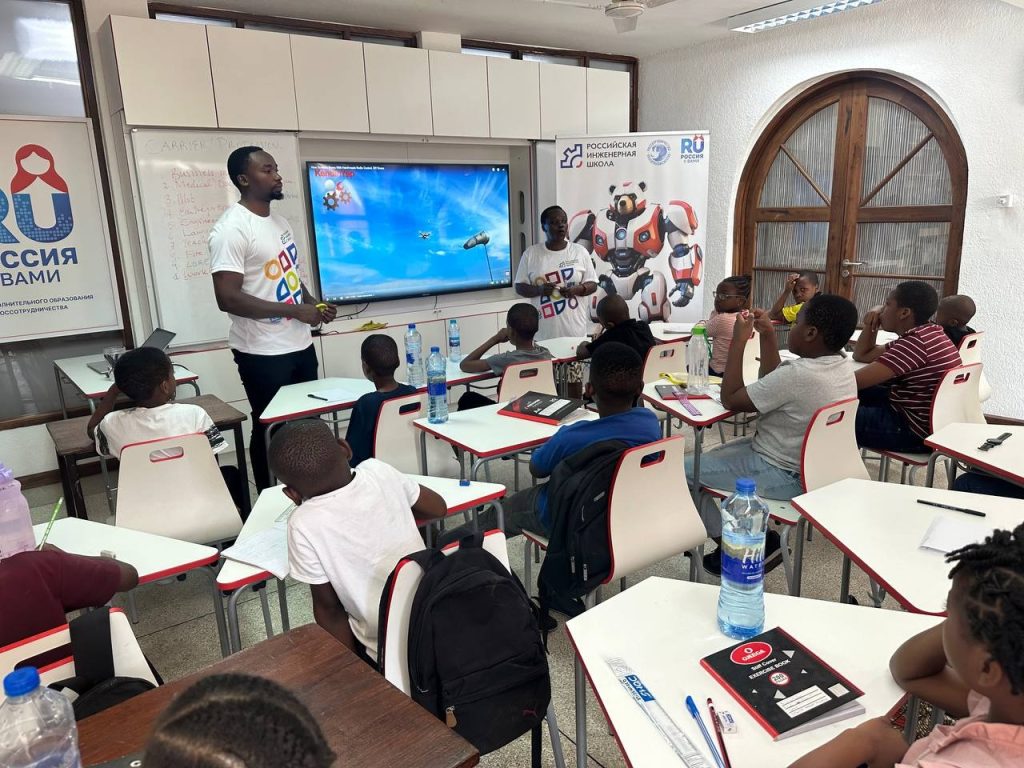
An intensive educational program for schoolchildren was held in the city of Dar es Salaam (Tanzania) as part of Rossotrudnichestvo’s international project “Russian Engineering School.” The program provided students with a unique opportunity to become familiar with cutting-edge technologies and master key principles of robotics in practice.
Three Tracks — Three Paths to an Engineering Future
Participants were offered a choice of three thematic directions, each revealing different aspects of robotics:
- “RoboWorld” — an educational immersion into the history and present of robotics: introduction to key inventions, global achievements, and development prospects of the industry;
- “Robotics is Simple and Interesting” — an introductory course where schoolchildren mastered the basics of robot construction and control;
- “Create Your Reality with Robots” — an in-depth track for those who sought to learn how to design robots for solving applied tasks.
Practice — The Foundation of Knowledge
The main feature of the program was its practical orientation. During the sessions, participants:
- studied the structure of robots and principles of their functioning;
- acquired skills in assembling mechanical structures;
- mastered the fundamentals of programming robotic systems;
- worked in teams on their own engineering projects.
Each track was built on the principle of “from simple to complex”: theory was immediately applied in practice. Under the guidance of experienced mentors, schoolchildren step by step created their own robots, experimented with various solutions, and developed engineering thinking. Special attention was paid to teamwork and finding unconventional approaches to problem-solving.
Grand Finale: “Battle of the Robots”
The climax of the intensive was a spectacular competition — “Battle of the Robots.” Machines assembled by participants during the program entered a specially equipped arena. The robots competed in:
- overcoming various obstacles;
- executing commands given by the operator;
- adapting to changing environmental conditions.
Although judges determined winners in individual categories, everyone without exception truly won. The main prize was the knowledge and skills gained, as well as firm confidence that robotics is accessible to anyone willing to learn and experiment.
Program Results
The intensive convincingly demonstrated that engineering disciplines are not only formulas and diagrams, but also a space for creativity, experimentation, and self-realization. By the end of the program, participants:
- mastered basic concepts and principles of robotics;
- acquired practical skills in construction and programming;
- learned to work effectively in teams on technical projects;
- learned about career prospects in engineering professions.
Organizers noted the high engagement of schoolchildren and their keen interest in engineering disciplines. Many participants expressed a strong desire to continue studying robotics and participate in subsequent stages of the project.
